How to Clean a Nylon Makeup Bag: Step-by-Step Instructions
Executive Summary
How to clean a nylon makeup bag is answered by four controlled steps rather than by a stronger cleaner: dry-brush the empty bag and its seams, wash it in water at or below 30°C with a pH-neutral liquid detergent at about half the label dose, clean the zip tape and slider separately with a soft brush, and dry it flat away from every direct heat source. Nylon is a polyamide filament that releases most cosmetic soil with mild chemistry. The three things that ruin a nylon pouch are hot water, chlorine bleach and machine drying, and all three are avoidable.
The rest of the method protects the parts that fail first: the polyurethane coating on the reverse of the fabric, the plating on the slider, and the printed lining. Detergent residue is itself a failure mode, because a film left on a coated shell attracts powder and reads as grey dirt within a week. Brand owners who specify nylon programmes should ask for colour fastness and coating adhesion evidence when the specification is written, not after the first customer complaint, using the ISO 105 colour fastness series and the AATCC laundering and crocking methods as the reference points.
Why nylon needs a different cleaning method from canvas and coated film
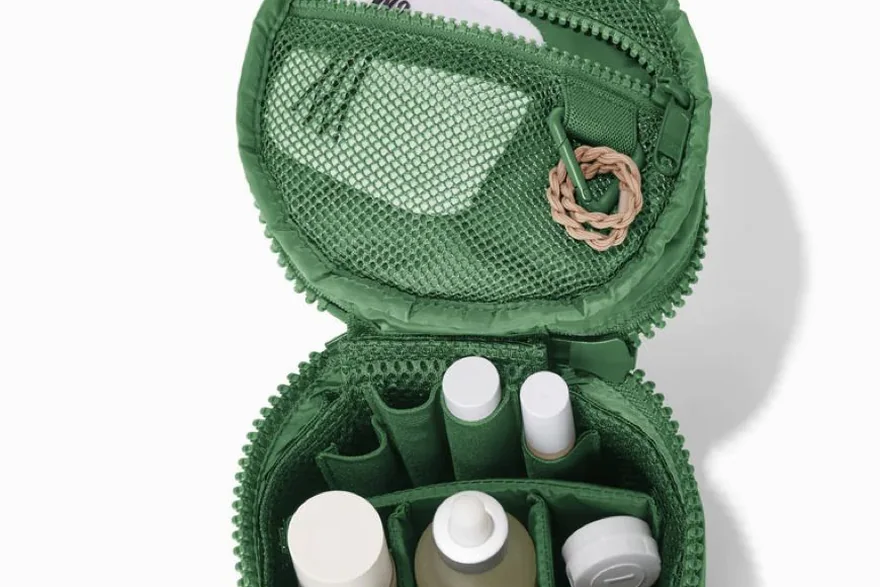
Nylon is a polyamide, not a cotton. It is extruded as a continuous filament, drawn, and woven into the fabrics used for makeup bags: 210D for lightweight pouches, 420D for the standard cosmetic bag shell, 840D for structured vanity cases, and ripstop or dobby weaves where tear resistance is specified. Filament yarn has no staple fibre ends to trap powder, so loose eyeshadow and blush brush away rather than grinding into the body of the yarn. That single property is why nylon releases dry cosmetic soil more readily than a cotton canvas pouch of identical size.
What nylon does not release easily is oil. Foundation, concealer, liquid lipstick and sunscreen are formulated with silicone fluids, ester oils and waxes that spread along a smooth filament instead of being absorbed into it. The soil collects in the interstices of the weave and along stitch lines, which is why seams, binding edges and zip tape are consistently the darkest parts of a used pouch. A cleaner aggressive enough to dissolve that oil is usually aggressive enough to attack the coating applied to the reverse of the fabric.
The coating is the hidden constraint in every cleaning decision. A 420D nylon shell commonly carries a polyurethane backing of roughly 0.02-0.05 mm for water resistance and body, and often a durable water-repellent finish on the face. Coatings tolerate water and mild detergent. They are attacked by solvents, by alkalis above about pH 10, and by sustained heat. Once a coating hydrolyses or delaminates it produces a milky haze that cannot be cleaned off, because the failure is inside the film rather than on it. Cleaning therefore has to be gentle enough to leave the film intact.
Nylon also has practical thermal limits far below its melting point. Polyamide 6 melts at roughly 215-220 °C, but creasing and coating damage begin well before that: a domestic tumble dryer running at 70-80 °C is sufficient to set permanent creases into a woven shell and to soften a backing. Cold to lukewarm processing is not a stylistic preference, it is the operating window.
Water temperature, detergent dose and the wash cycle
Temperature does two opposite things at once. Warmth lowers the viscosity of the oils in foundation and concealer, which helps them release, but it also softens the polyurethane backing and relaxes the heat-set memory of the woven fabric. Between 20 °C and 30 °C the first effect is mostly achieved and the second is mostly avoided. Above 40 °C the balance reverses: oil can be driven deeper into the weave and set, and creases formed in a drum become permanent.
| Parameter | Hand wash (recommended) | Machine wash (if unavoidable) | Never |
|---|---|---|---|
| Water temperature | 20-30°C, comfortable to the hand | Cold wash, 20-30°C, delicate cycle | Above 40°C - sets oils and creases coating |
| Detergent type | pH-neutral liquid, no bleach, no brightener | Same liquid, no powder | Chlorine bleach or high-alkali powder |
| Detergent dose | 5 ml per 5 litres of water | 10-15 ml for a full drum | Full label dose - residue holds soil |
| Agitation | Gentle squeezing, 5-8 minutes contact | Short delicate cycle, 400-600 rpm spin | Heavy-duty cycle or spin above 800 rpm |
| Rinse | Two full changes of clear water | Extra rinse enabled | Single rinse leaving a detergent film |
| Immediately after | Press in a towel, reshape while damp | Remove from the drum at cycle end | Leaving the bag wet and crumpled |
Detergent choice matters more than detergent quantity. A pH-neutral liquid in the range of pH 6.5-7.5 will lift silicone and ester oils from filament yarn without hydrolysing a polyurethane film. Enzyme detergents are unnecessary on makeup soil and are best avoided on bags with wool or silk trim. Optical brighteners deposit a bluish cast on pale linings. Chlorine bleach must be ruled out entirely: it attacks the amide linkages in polyamide, leaving a yellow cast that no subsequent wash removes, and it embrittles the filament so the fabric later tears at the stitch line. On white nylon only, an oxygen-based bleach diluted to the label rate and used below 40 °C is an acceptable substitute, tested first on an inner seam.
Fabric softener should be skipped on every nylon cosmetic bag. Softener works by depositing a cationic film, and that film both destroys the beading of a water-repellent finish and gives powder something to cling to. A final rinse of one part white vinegar to four parts water does the opposite job: it removes detergent film and neutralises odour. Keep the vinegar away from plated hardware, since acetic acid dulls plating within a minute or two of contact, and follow it with a clean-water rinse.
- Empty every compartment, invert the bag and shake out loose powder, then brush seams and binding with a dry soft brush.
- Fill a basin with 5 litres of water at or below 30°C and dissolve 5 ml of pH-neutral liquid detergent.
- Close the zip, submerge the bag and squeeze it gently through the water for 5-8 minutes; do not wring or twist.
- Work the soiled lining, seams and zip tape with a soft brush, using the detergent solution, not a separate cleaner.
- Drain and refill twice with clear water until no suds appear when the bag is squeezed.
- Add a final rinse of one part white vinegar to four parts water only if detergent film or odour remains.
- Press the bag inside a towel to remove bulk water, reshape the panels, and dry flat in moving air.
Machine washing is a fallback, not a default. It is reasonable for an unstructured pouch with no printed logo and no metal hardware, placed inside a mesh laundry bag with the zip closed and the dose halved. It is not reasonable for a structured case with a foam laminate, a heat-transfer logo or plated metal feet, where the tumbling action does more damage than the water does. When a machine is used, the cycle must end with the bag removed immediately; a coated bag left crumpled and wet in a drum for an hour will crease.
Zip tape, slider, lining and hardware during cleaning
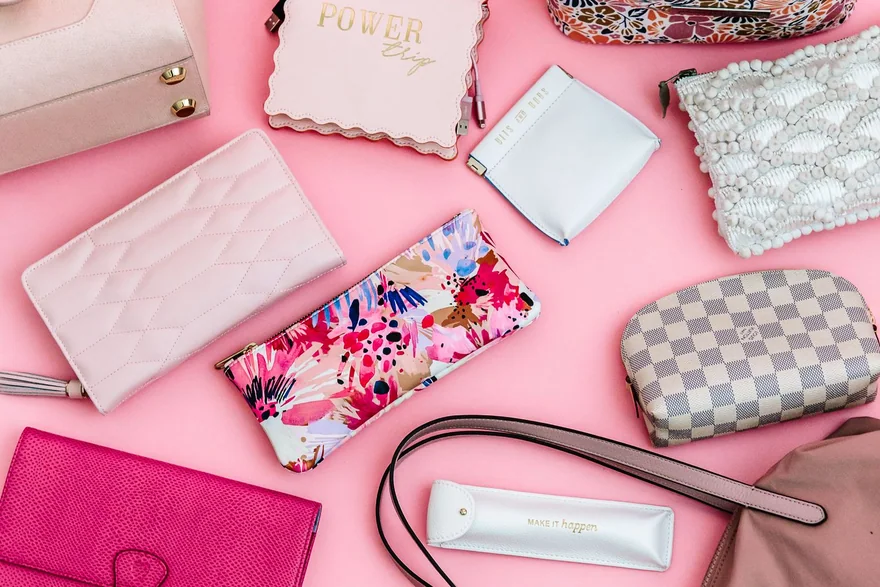
Zippers fail from grit long before they fail from wear. A cosmetic bag zip runs through powder fallout daily, and powder mixed with the oil from a fingertip becomes an abrasive paste inside the chain. Zipper components have their own vocabulary - tape, chain, slider and puller - defined in ASTM D2053 zipper terminology, and each part has a different cleaning requirement. The chain should be cleaned dry first, the tape with detergent solution second, and the slider dried immediately.
Close the zip before the bag goes anywhere near water. An open slider catches on the lining and can tear the tape stitching in a single pull, and the top stop is not designed to hold the chain together once it is off the track. Brush the chain dry with a soft brush to lift compacted powder, then wipe along the teeth with a barely damp cloth and a drop of the same mild detergent solution used for the shell. Rinse by wiping with a clean damp cloth, and dry the slider and puller with a towel within minutes, because zinc-alloy hardware pits if it is left wet.
Lubrication is where most bag zips are ruined. Oil and grease turn residual powder into a paste that packs into the chain and accelerates wear, so neither should ever be applied. If a slider drags after cleaning, the cause is usually dried detergent in the chain rather than a lack of lubricant: re-rinse, dry, and run the slider back and forth a dozen times. Only a dry film zip lubricant, applied sparingly and wiped off the tape, is acceptable on a bag that will sit in a makeup kit.
- Close the zip before washing: an open slider catches lining and tears tape stitching.
- Dry-brush the chain before any water touches it; grit is what removes plating from the slider.
- Never oil or grease a bag zip - it binds powder into an abrasive paste.
- Dry sliders, pullers and metal feet within minutes of rinsing; zinc alloy pits when left wet.
- Test printed linings and heat-transfer logos with a damp white cloth before the first full wash.
- Skip fabric softener on any bag with a water-repellent finish; the residue kills beading and holds soil.
The interior deserves separate attention. Linings are usually a printed polyester or nylon taffeta at 60-90 g/m², and the print is the weakest element: pigment that transfers onto a white cloth in a dry rub will certainly transfer in water. Elastic loops and mesh pockets introduce two more limits. Spandex in elastic degrades above roughly 60 °C and loses recovery, so heat must stay out of the process entirely, and mesh pockets should be brushed rather than scrubbed because a monofilament mesh snags on a stiff brush and runs.
Hardware beyond the zip needs the same discipline. Magnetic snap closures rust at the plated edge if they are stored damp, and metal feet on a structured case will leave rust rings on a towel and then on the bag itself. Wipe each metal component dry, then leave the bag open with the hardware exposed to air for an hour before it goes back into service. If a magnetic closure has already spotted, a dry brush followed by a wipe with a barely damp cloth is the extent of safe treatment; abrasive pads remove plating along with the rust.
Drying away from heat, reshaping and verifying the result
Drying is where a correctly washed bag is most often damaged. Water leaves a coated nylon shell by evaporation from the face and the lining, and the coating slows that process. Any attempt to accelerate it with heat attacks the film rather than the water. The safe method is mechanical water removal first - pressing the bag inside a towel - followed by evaporation in moving air at room temperature. A small desk fan placed a metre away moves more water in an hour than an hour of direct sun does, without the ultraviolet load.
| Drying method | Typical temperature | Time for a 20-25 cm pouch | Risk to the bag |
|---|---|---|---|
| Flat on a towel in moving air | 20-25°C ambient | 6-10 hours | Lowest - the reference method |
| Hanging by the wrist loop | 20-25°C ambient | 8-12 hours | Medium - weight pulls panels out of shape on structured cases |
| Rolled and pressed in a towel | 20-25°C ambient | Pre-dry only, 10 minutes | Low - use before flat drying |
| Tumble dryer, low setting | 60-70°C | 30-40 minutes | High - coating haze and permanent creasing |
| On or above a radiator | 50-70°C surface | 3-5 hours | High - delamination of the backing |
| Direct sunlight | 30-45°C plus UV | 4-6 hours | High - yellowing of white nylon, dye fade |
| Hair dryer on hot | 60-90°C at the nozzle | 10-15 minutes | Severe - local melting and hazing of the film |
Reshaping happens while the bag is damp, not after it is dry. Turn the bag the right way out, open every compartment, and push the corners out from the inside with a folded towel. A structured case should be lightly filled with a dry white towel so the panels hold their geometry while the last of the water leaves; a rolled white towel is the right filler and newspaper is not, because printing ink transfers onto a damp lining. Quilted and padded panels take longest and should be turned once during drying so the underside is not left wet against the towel.
Colour fastness to washing and to rubbing is measured under the ISO 105 colour fastness series, and the laundering and crocking procedures used most often in North America sit in the AATCC test methods catalogue. A buyer does not need to run those tests on a single pouch, but a brand owner writing a specification should require the shell and lining to be tested to them, because a lining that bleeds at the first wash will stain everything packed next to it.
Verification after drying takes two minutes and catches the failures that matter. Rub a clean white cloth firmly over the lining and over any printed logo and check for colour transfer. Run the zip end to end twice and confirm that the slider tracks without catching and that the teeth align at the top stop. Splash a few drops of water on the outer face: if the shell still beads, the water-repellent finish survived; if it wets out evenly, the finish has gone and the bag will now absorb spills rather than shedding them. Check the interior for any residual odour, which indicates that detergent film or moisture is still present.
A cleaning schedule keeps all of this short. A daily-use pouch needs a weekly dry brush-out, a spot clean the day a spill happens, and a full wash every four to six weeks. Bags stored in a humid bathroom should be emptied and aired monthly even when they look clean, because mildew grows on residue rather than on the polyamide itself. Retire a bag when the coating has delaminated across more than a quarter of the shell, when the zip tape has torn from the chain, or when the fabric has gone stiff from bleach damage - those are structural failures that no cleaning method reverses.
The B2B Customisation View
Before a single metre of fabric is cut, the briefing stage settles the silhouette, the lining, the closure and the branding method for makeup bags and toiletry bags.
Standard terms: 500 pieces minimum per style and colourway, 6–10 working days for sampling (12–15 for complex builds), 35–50 days bulk production, AQL 2.5 inspection under ISO 2859-1, FOB Xiamen, T/T 30 deposit / 70 balance.
The commercial arrangement is straightforward: one sourcing partner, one technical pack, one inspection standard, one consolidated shipment.
Which Brand Types Benefit Most
Nylon care guidance lands differently depending on who is buying. A start-up brand launching its first 500-piece run per style and colourway is usually selling on a promise of easy care, so the care instruction printed on the hangtag is part of the product and has to match what the fabric can actually survive. An established brand with a standing assortment has the opposite problem: the care copy has to stay identical across repeat runs, which means the fabric, coating and hardware have to be locked in the specification rather than substituted at the last minute. Retailers care about what happens in the returns loop, where a bag that hazed after one wash comes back with a photograph attached.
- Start-up brands: specify shell denier, coating type and a wash-tested lining on the first sample, then write the care copy from the test result rather than from a template.
- Established brands: lock the coating and slider finish across repeats so the care instruction never has to change, and re-test colour fastness on every new colourway.
- Retailers and chain buyers: require a care label and a hangtag that state a temperature, not the word "cold", so store staff can defend a return decision.
- E-commerce sellers: photograph the bag after a test wash before listing it, since haze and creasing are the two defects that drive negative reviews on coated nylon pouches.
- Gift and hospitality buyers: confirm the bag can be wiped clean between uses, because amenity and gifting programmes rarely include a washing step.
The commercial calendar is unaffected by any of this but still frames it. Sampling runs 6-10 working days for a standard construction, or 12-15 working days where the build is complex, and bulk follows 35-50 days after sample approval. A colour fastness retest costs days, not weeks, when it is booked at the specification stage, and it should be treated as part of the sample approval rather than an afterthought. Inspection to AQL 2.5 under ISO 2859-1 covers visible defects such as coating haze and zip damage on the finished run, with shipment on FOB Xiamen terms and payment by T/T, 30 per cent deposit and 70 per cent against the bill of lading.
Frequently Asked Questions
What water temperature is safe for washing a nylon makeup bag?
Water at 30°C or below is safe for a nylon makeup bag, and 20-25°C is safer still for a coated shell. Polyamide filament releases cosmetic oil readily at that temperature while the polyurethane backing on the reverse of the fabric stays stable. Above 40°C the coating softens, oil-based foundation can set rather than lift, and creases formed during washing become permanent. Hand washing in a basin gives the closest control over temperature.
How much detergent should be used to hand wash one nylon cosmetic pouch?
About 5 ml of pH-neutral liquid detergent in 5 litres of water is enough for a single 20-25 cm pouch, which is roughly half the label dose for a full load. Nylon has low moisture regain of around 4-4.5 per cent, so it holds very little water and very little soil. Excess detergent cannot be rinsed out of a coated fabric, and the residue film then attracts powder. Rinse twice in clean water until no suds remain.
Can a nylon cosmetic bag go into a washing machine?
A nylon cosmetic bag can go into a washing machine only on a delicate cycle at 20-30°C, inside a mesh laundry bag, with the zip closed and the detergent dose halved. Machine washing is acceptable for an unstructured pouch with no printed logo and no metal hardware. It is not acceptable for a structured case with a foam laminate, a heat-transfer logo or plated metal feet, where tumbling does more damage than the water.
Why does chlorine bleach turn nylon yellow and what should replace it?
Chlorine bleach attacks the amide linkages in polyamide and leaves a permanent yellow cast that no further washing removes. It also embrittles the filament, so the fabric tears at the stitch line weeks later. On white nylon, an oxygen-based bleach diluted to the label rate and used below 40°C is the alternative, tested first on an inner seam. On coloured or printed nylon no bleach of any type should be used.
How should the zip on a nylon makeup bag be cleaned?
Close the zip, dry-brush the chain with a soft brush to lift powder and grit, then wipe along the teeth with a barely damp cloth and a drop of the same mild detergent solution. Rinse with a clean damp cloth and dry the slider immediately with a towel. Grit left in the chain is abrasive and strips the plating from the slider, which then snags the tape. Oil and grease must never be used as zip lubricants.
Can a nylon cosmetic bag be tumble dried on a low setting?
No. Even a low tumble setting runs at 60-70°C, which is enough to soften a polyurethane backing, set creases into a woven shell and degrade elastic loops or binding tape containing spandex. A hair dryer is worse because the nozzle delivers localised heat above 80°C directly onto the film. Dry the bag flat on a towel in moving air at room temperature instead, which takes 6-10 hours for a small pouch.
How is foundation lifted from the lining of a nylon makeup bag?
Turn the bag inside out, blot any fresh foundation with a dry cloth without rubbing, then work a diluted pH-neutral detergent solution into the mark from the outside towards the centre using a soft brush. Allow 5-8 minutes of contact time, rinse with a clean damp cloth and blot dry. Silicone-rich formulations respond to a second or third pass rather than to a stronger cleaner. Move to a solvent only after three attempts.
Is white vinegar safe to use on a nylon cosmetic bag?
White vinegar diluted to roughly one part vinegar to four parts water is safe on nylon and useful as a final rinse to remove detergent film and neutralise odour. It should not stay in contact with metal hardware or a plated slider for more than a minute or two, because acetic acid dulls plating. Rinse with clean water afterwards. Vinegar does not remove oil-based makeup by itself; it is a rinse aid, not a cleaner.
How long does a washed nylon makeup pouch take to air dry?
An unstructured 20-25 cm nylon pouch pressed in a towel and dried flat in moving air at 20-25°C dries in 6-10 hours. A structured vanity case with a foam laminate and a separate lining takes 18-24 hours, and a bag with a quilted padded panel can take up to 36 hours. Turn it once and replace the towel underneath. Heat shortens the drying time but damages the coating.
What causes a white haze on a coated nylon bag after washing?
A milky haze on coated nylon is usually one of three things: detergent residue that was never rinsed out, hydrolysis of the polyurethane backing from water above 40°C, or delamination of the film from tumbling and heat. The first is reversible, since rewashing in clean water with no detergent and blotting will clear it. The second and third are not reversible; the film itself has failed and the panel needs replacing rather than cleaning.
How often should a nylon makeup bag be cleaned?
A nylon makeup bag in daily use needs a full wash every four to six weeks and a dry brush-out of loose powder weekly. Bags carrying liquid foundation or sunscreen benefit from a spot clean the moment a spill happens, because silicone oils spread along filament yarns within hours. A bag stored in a humid bathroom should be emptied and aired monthly even when it looks clean, since mildew grows on residue rather than on the nylon.
Should a nylon cosmetic bag be turned inside out before washing?
Turning a nylon cosmetic bag inside out is correct when the lining is the soiled part, which it usually is. It exposes seams, binding edges and the lining panel to the detergent and protects the outer face and any logo from abrasion. The zip should stay closed, and the bag belongs in a mesh laundry bag if it goes into a machine. Turn it back the right way while still damp so the panels dry flat.
How is odour removed from a nylon makeup bag without a scented spray?
Odour in a nylon bag comes from residue rather than from the fabric. Wash at 30°C with a pH-neutral detergent, add a final rinse of one part white vinegar to four parts water, then dry completely in moving air. Once dry, leave the bag open with a small sachet of dry bicarbonate of soda in an interior pocket overnight and shake it out. Scented sprays mask the smell and leave an oily film that holds powder.
Will a printed logo on a nylon bag survive washing?
A screen-printed logo on nylon survives hand washing at 30°C well, but it is vulnerable to abrasion, so the printed panel should never be scrubbed. A heat-transfer logo is more vulnerable and can lift at the edges after repeated washing or after any contact above 60°C. Embroidery is the most durable option for a bag washed often. Test any print with a damp white cloth before the first full wash.
When should a nylon cosmetic bag be retired rather than cleaned?
Retire a nylon cosmetic bag when the coating has delaminated across more than a quarter of the shell, when the zip tape has torn away from the chain, when the lining has split at a seam, or when the fabric has gone stiff and brittle from bleach damage. These are structural failures that no cleaning method reverses. A bag with a single failed zip can be repaired if the tape and stitching are intact; failed coating cannot be repaired.
People Also Ask
Can you put a makeup bag in the washing machine?
A nylon or polyester makeup bag can go in a washing machine on a delicate cycle at 20-30°C in a mesh laundry bag with the zip closed, but leather, suede, PVC film and structured foam-laminated cases should never be machine washed. Machine washing shortens the life of printed logos and plated hardware. Hand washing in a basin at the same temperature is always the lower-risk option and takes about ten minutes.
How do you get makeup out of a makeup bag?
Empty the bag, brush out loose powder, then treat the remaining marks by stain type: oil-based foundation and concealer with pH-neutral detergent and lukewarm water, pigment with a damp cloth worked from outside in, and nail polish only with a solvent the surface tolerates. Work on the lining with the bag inside out. Blot rather than rub, and dry away from heat so any remaining oil is not set.
Does hot water shrink nylon?
Hot water does not shrink nylon the way it shrinks cotton canvas, because polyamide filament is heat-set during finishing and has very low moisture regain. What water above 40°C does do is soften the polyurethane coating on the reverse of the fabric, set oil-based stains, and relax heat-set creases into permanent wrinkles. Nylon should be washed at 30°C or below and dried with no heat at all.
What is the best way to dry a nylon bag?
Dry a nylon bag flat on a towel in moving air at room temperature, away from radiators, direct sun and tumble dryers. Press it inside a towel first to remove bulk water, reshape the panels while damp, and turn it once. A small pouch dries in 6-10 hours and a structured case in 18-24 hours. Do not hang a wet structured bag by its loop, as the weight pulls the panels out of shape.
Request a Sample or a Written Quotation
Send the silhouette, dimensions, material preference and logo artwork, and the programme team will return a written quotation with MOQ, sampling window, bulk lead time and inspection standard.
Email: service@junyuanbags.com · WhatsApp: +86 177 5002 0688