Honeymoon Cosmetic Bags: Romantic Travel Gifting
Executive Summary
A honeymoon cosmetic bag works as a romantic travel gift when three things are specified together: a personalisation method that survives daily use, a shell with a gift-grade hand feel, and packaging that arrives undamaged. Embroidery at 6,000-9,000 stitches or a debossed patch outperforms foil stamping on soft shells, because foil cracks where a bag flexes at the corners. A satin or velvet shell of 110-260 g/m2 with a brushed or rose-gold finish reads as gift rather than as luggage, and a rigid box with a belly band protects that impression in transit.
Commercially, a honeymoon gift programme is a date-driven buy with a short selling season. Weddings cluster in late spring and early autumn, so the brief has to be signed around 100-120 days before the retail or shipping date. Orders run at a minimum of 500 pieces per style and colourway, sampling takes 6-10 working days or 12-15 for complex constructions, bulk production runs 35-50 days after sample approval, inspection is to AQL 2.5 under ISO 2859-1, and shipment is FOB Xiamen with T/T 30 deposit, 70 against bill of lading.
Why honeymoon gifting asks for a different brief than travel retail
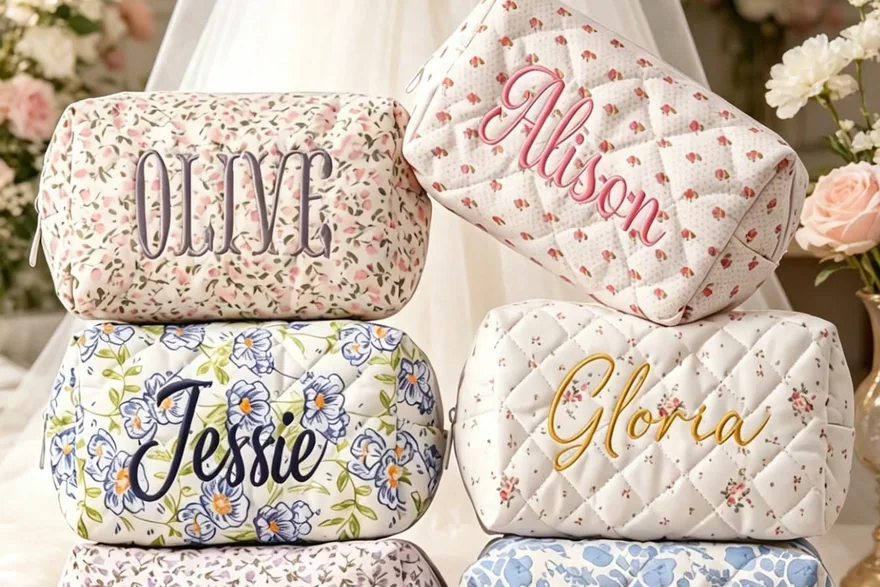
A toiletry bag bought for a flight is judged on leakage and capacity. A cosmetic bag bought as a honeymoon gift is judged in the first four seconds, before it is ever opened, and then again after four weeks of daily use on a trip that includes sunscreen, salt water and at least one repack. That double judgement changes what belongs in the brief. Function still matters, but the specification now has to protect an impression: the shell has to photograph well under warm retail lighting, the personalisation has to look considered rather than applied, and the packaging has to survive the courier network without a crushed corner.
The buyer profile also changes. A honeymoon cosmetic bag is rarely bought by the traveller; it is bought by a partner, a bridesmaid, a parent or a wedding guest, which means the purchase decision is made by someone who will not use the product. That pushes the specification towards universal fit: a size that suits both a minimal packer and a full kit, a colourway that works with an unknown bathroom, and a personalisation format that does not require the buyer to know a size, a shade or a preference. Gift buyers also return more readily, so the specification has to be defensible on what it does, not only on how it looks.
Seasonality is the third difference. Honeymoon travel follows the wedding calendar, and in most markets weddings cluster from May to June and from September to October, with a secondary December peak around holiday proposals and elopements. A programme therefore has two narrow demand windows rather than a steady baseline, and a buyer who misses a window cannot recover it by discounting later, because the couple is already on the trip. That is why the sampling and packaging decisions below are sequenced against a wedding date rather than against a retail month.
Finally, gifting carries a compliance and safety expectation that travel retail does not. A bag sold as a gift in the European Union has to meet chemical requirements under EU REACH, and most gift buyers will ask for a textile certificate such as OEKO-TEX Standard 100 on the shell and lining. Neither is optional once the product is marketed to a bride rather than to a backpacker.
Personalisation methods ranked for a romantic gift programme
Personalisation is the reason a honeymoon cosmetic bag sells, and it is also the most common source of returns, because the method that looks best on a flat photograph is frequently the one that fails first in use. The decision has three inputs: the shell it sits on, where on the bag it sits, and how much flex that panel sees when the bag is packed and unpacked. A flat front panel that is stabilised by an internal board can carry almost any method; an unstructured satin panel that creases in a suitcase cannot.
Letter height is the first number to fix. On a satin shell, embroidery below 6 mm in cap height loses definition because the satin stitch cannot resolve the counter of an A or an O, and the monogram reads as a smudge in photography. Chenille and puff embroidery solve resolution at small sizes but add thickness that distorts a soft shell. Hot foil looks crisp at 4 mm but cracks along the crease line where a bag folds. A debossed patch sidesteps both problems by moving the personalisation onto a stable substrate that is then applied to the bag.
| Method | Minimum cap height | Durability in use | Effect on unit cost | Programme note |
|---|---|---|---|---|
| Flat embroidery, 6,000-9,000 stitches | 6 mm | Excellent; survives laundering | Moderate; priced by stitch count | Best all-round choice on satin and twill |
| Puff or chenille embroidery | 10 mm | Good; foam can flatten after compression | Higher; two passes plus foam | Use only on a stabilised front panel |
| Hot-foil stamp on PU or coated shell | 4 mm | Poor on soft shells; cracks at folds | Low per unit, high plate charge | Restrict to a flat, board-backed panel |
| Debossed PU or silicone patch | 3 mm | Excellent; no thread to snag | Moderate; tooling plus application | Ideal when buyer wants small initials |
| Laser-engraved metal zipper pull | 2 mm | Excellent; hardware-grade finish | Low; priced per pull | Adds perceived value at low cost |
| Woven damask label, sewn in seam | 3 mm | Excellent; no surface wear | Low | Best for a discreet two-date mark |
| Digital sublimation on polyester | Unlimited | Good; no hand feel change | Low; no plate or tooling | Requires 65%+ polyester shell |
| Water-based screen print | 5 mm | Fair; crazes after 20-30 washes | Lowest | Acceptable for a short-life gift |
Placement matters as much as method. The two positions that survive are the lower-left front panel, where the shell is least flexed, and a woven label in the side seam. The two positions that fail are across a zipper line and centred on an unstructured gusset. For a his-and-hers pair, the usual approach is one shared monogram letter placed identically on both bags, which keeps a single digitising file and one machine setup across the pair rather than two different placements.
The commercial mechanics follow from the method. Embroidery and patches carry a digitising or tooling charge plus a per-unit application cost, and both are amortised over the run, which is why a 500-piece order per style and colourway is the practical floor: below that, the setup charge dominates the unit cost. Names and dates are handled differently from monograms. Because a per-unit variable name breaks run efficiency, most programmes either sell the bag blank and personalise at point of sale with a heat press, or offer a fixed set of initials, typically the 26 letters, ordered as a pre-pack.
Zipper hardware is the cheapest upgrade in the whole specification and the one most buyers miss. An engraved metal pull with a logo or a date costs a small increment per unit and reads in photography as a considered detail, particularly in a warm finish against a pale shell. Terminology for the pull, slider and tape should be fixed using ASTM D2053 zipper terminology so that a sample rejection is described in standard terms rather than in adjectives.
Hand-feel, lining and hardware: the sensory specification
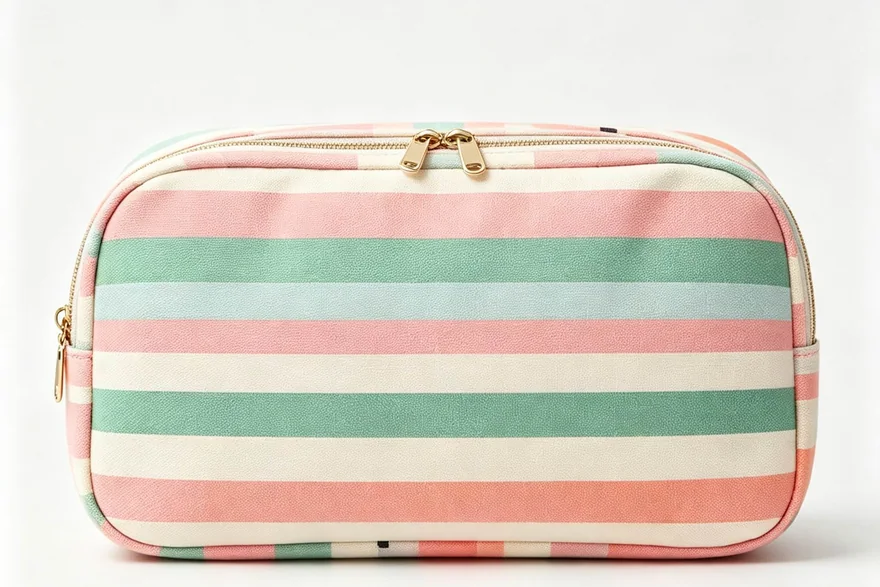
Gift buyers touch the product before they read the copy, and honeymoon bags are bought in a category where touch decides. The specification should therefore name the hand feel in physical units rather than in adjectives: fabric weight in g/m2, coating thickness in mm, pile height in mm, and hardware finish by plating process. That converts a subjective argument with a sample room into a measurable acceptance criterion, and it makes a re-order repeatable a year later when the original fabric lot is no longer available.
- Shell, satin look: polyester satin at 110-140 g/m2 with a soft finish; below 100 g/m2 the fabric reads as lining, not as shell.
- Shell, velvet look: polyester velvet at 200-260 g/m2 with a 1.0-1.5 mm pile; crush-resistance should be tested after 24 hours compressed.
- Shell, leather look: PU at 0.6-0.8 mm on a 0.45 mm knit backing, 320-420 g/m2, with a hydrolysis resistance target of three years.
- Lining: peach-skin polyester at 80-100 g/m2, pale enough to show a leak but not so pale that lipstick transfers permanently.
- Hardware: brushed gold, rose gold or gunmetal electroplate over a zinc alloy base, with a 24-hour neutral salt spray acceptance.
- Zipper: #5 coil with a metal-look tape and an engraved pull on the main bay, #3 on the interior pocket.
- Colour match: shell, lining, trim and print held to a Delta E of 1.5 or less against the approved reference under D65 lighting.
- Odour: low-VOC adhesives and inks, with a smell assessment 24 hours after unpacking from the polybag.
Colour is where honeymoon programmes most often lose money. Ivory, champagne and blush are the core gift shades, and each is a low-saturation colour in which a dye-lot variation of even a small amount is visible to the eye once the shell, lining, zipper tape and print sit next to each other. Buyers should approve a single physical reference card and hold all four components to it, rather than approving each component separately. A dark berry or forest shell has the opposite problem: it crocks onto a pale lining, which is why a rubbing assessment against the ISO 105 colour fastness series is worth requesting before a bulk dye lot is committed.
Lining choice deserves more attention than it usually gets, because the honeymoon use case is the hardest one a lining faces. Sunscreen at SPF 50, body oil and salt water all migrate, and a peach-skin polyester at 80-100 g/m2 with a light durable-water-repellent finish wipes clean where an untreated cotton lining stains permanently. For brands that want a natural-fibre story, an organic cotton lining certified to GOTS is available, but it should be paired with a removable liquids pouch rather than relied on as the primary barrier.
Hardware finish drives photography more than any other component. A polished gold finish blows out under warm retail lighting and photographs as white; a brushed or satin finish holds its tone and reads as metal. Rose gold is the most requested honeymoon finish and the hardest to match between zipper tape, pull and logo plate, because three different plating baths are usually involved. Requesting all metal-look components from one supplier in one finish reference avoids the mismatch that otherwise shows in a listing photograph.
Chemical compliance closes the sensory specification. A gift bag sold in the EU must satisfy REACH restrictions on substances of very high concern, and buyers selling into nursery, teen or general gift channels usually add OEKO-TEX Standard 100 certification on shell, lining and thread. Both documents set the requirement; the buyer's tech pack should also state the acceptance evidence, typically a valid certificate number and scope covering the article class, so that a marketplace listing can be defended if challenged.
Packaging, seasonality and the gifting sampling calendar
Packaging is not decoration in a gift programme; it is the difference between a delivered product and a returned one. A satin bag shipped loose in a carton arrives with compression creases that no amount of steaming removes, and a rigid box adds roughly 2-3 cm on each dimension and 180-320 g per unit, which changes the carton count and the freight bill. The decision therefore has to be made in the same meeting as the volume plan, not after it.
| Component | Practical specification | Why it matters | Cost driver |
|---|---|---|---|
| Rigid lid-and-base gift box | 1.5-2.0 mm greyboard, 157 gsm art paper wrap | Protects the shell from compression creases | Board thickness and wrap print |
| Tissue wrap or non-woven sleeve | 17-22 gsm tissue, two sheets | Prevents hardware rubbing on the shell | Sheet count per unit |
| Belly band or sleeve | 250-300 gsm card, one-colour print | Carries the monogram story on shelf | Print colours and die-cut |
| Care and materials card | 90-120 gsm, folded to 90 x 55 mm | Answers the gift recipient's first questions | Per-unit print, negligible |
| Ribbon or grosgrain pull | 9-15 mm wide, heat-cut ends | The single strongest gift signal in photography | Width and material |
| Outer mailer | B-flute or E-flute, sized to box + 10 mm | Survives the courier network | Flute grade and print |
The calendar then compresses everything. Working backwards from a June wedding season, the brief needs signing in February, sampling runs in February or March, bulk production lands in April and May, and sea freight with inland delivery of 25-35 days puts the goods on the shelf in late May. A buyer targeting September weddings signs in May. Because sampling takes 6-10 working days for a standard construction and 12-15 working days for a complex one such as a board-backed box-and-bag set, the packaging decision has to be made before the bag sample is even cut, or the second sampling round pushes the whole programme past the season.
Carton maths follows the packaging choice. A gift-boxed satin pouch at 24 x 16 x 9 cm and 320 g with a rigid box packs roughly 30 units per carton of 60 x 40 x 40 cm, so a 500-piece order is about 17 cartons and 1.63 CBM at roughly 11 kg gross per carton. The same bag shipped unboxed at 40 units per carton is 13 cartons and about 1.25 CBM. That 30% difference in cube is the actual cost of the rigid box, and it is usually larger than the per-unit box price.
Commercial terms are unchanged by the gifting context: 500 pieces per style and colourway, inspection to AQL 2.5 under ISO 2859-1 with the sampling plan sized to the lot, shipment FOB Xiamen, and payment T/T 30 deposit, 70 against bill of lading. What changes is the defect definition. In a gift programme, a creased shell, a misaligned monogram and a scuffed box corner are all classified as major defects, because a gift recipient does not distinguish between a functional fault and a cosmetic one. Writing that into the inspection criteria before bulk is the cheapest quality decision in the programme. Specifications and drawings can be sent to service@junyuanbags.com for a feasibility review and a sampling slot against the wedding season.
The B2B Customisation View
Development of makeup bags and toiletry bags is a sequence of small approvals, and each approval is cheaper than the rework it prevents.
The numbers a buyer can plan around: 500 pieces minimum per style and colourway, 6–10 working days to a first sample (12–15 where tooling or moulding is involved), 35–50 days to bulk completion, AQL 2.5 under ISO 2859-1 at final inspection, FOB Xiamen terms, T/T 30/70 payment.
As the programme coordinator, QUANZHOU JUNYUAN BAGS owns the sample history, which is what makes a repeat order of makeup bags and toiletry bags look like the original rather than a near-miss.
Which Brand Types Benefit Most
Honeymoon cosmetic bags reward five buyer profiles in different ways. Bridal and occasion retailers get a product that sits naturally beside a robe, a hanger and a keepsake box, and that carries a margin the category supports because it is bought as a gift rather than compared on spec. Established beauty brands use the honeymoon bag as a gift-with-purchase at a price point that would be hard to justify as a standalone sale, which is why the packaging spec matters more than the capacity spec. Travel brands add it as a seasonal colourway of an existing shell, and a hotel or resort group uses it as a turndown or welcome amenity for honeymoon suites, where the monogram is the group's own mark rather than the couple's initials. Across all five, the specification that converts is the same: a hand feel that reads as gift in the first four seconds, a personalisation method that survives the trip, and packaging that arrives undamaged.
- Start-up brands: a monogram-ready satin pouch is one of the few cosmetic bag products where a small brand can charge a gift price on a 500-piece buy.
- Established brands: the honeymoon SKU reuses an approved shell and lining platform, so sampling usually stays inside the 6-10 working day window.
- Retailers and bridal chains: pre-packs of initials, typically the 26 letters, turn a personalised product into a shelf-ready assortment, and a 17-carton gift-boxed order suits a chain-wide display without a second delivery.
- E-commerce sellers: photography decides the listing, so the brushed hardware finish and the ribbon detail are worth more than extra capacity.
- Hospitality and resort buyers: a house monogram on a debossed patch gives a durable amenity bag that guests keep, that photographs in reviews, and that survives the commercial laundering a standard embroidered satin pouch will not.
Frequently Asked Questions
What monogram letter height works on a satin honeymoon cosmetic bag?
Six millimetres of cap height is the practical floor for flat embroidery on satin, because below that the stitch cannot resolve the counter of an O or an A and the monogram reads as a smudge in photography. Puff embroidery needs 10 mm or more. If the buyer wants small initials, move to a debossed patch at 3 mm or an engraved zipper pull at 2 mm.
Which personalisation method survives four weeks of honeymoon use?
Flat embroidery at 6,000-9,000 stitches and debossed patches both survive; hot foil does not. Foil is crisp at 4 mm on a flat panel but cracks along the crease line where a soft shell folds in a suitcase. Sublimation on a 65%+ polyester shell also performs well and adds no hand-feel change, but it cannot produce a metallic finish.
How is an ivory shell matched to a champagne lining without visible shade drift?
Approve one physical reference card and hold shell, lining, zipper tape and print to it at a Delta E of 1.5 or less under D65 lighting. Approving each component separately is what causes drift, because each supplier matches to its own standard. Low-saturation shades such as ivory, champagne and blush show variation most clearly, and the card should be re-approved under the lighting the product will be photographed in, because warm retail lighting shifts these tones more than daylight does.
Does hot-foil stamping crack on a PU cosmetic bag?
Yes, on any panel that flexes. Foil sits on the surface rather than in the substrate, so a fold radius under about 8 mm will crack it within a few packing cycles. Foil is acceptable on a board-backed flat panel or a rigid gift box, and it remains the lowest unit cost method for a large, one-colour logo. Keep it off gussets and zipper lines.
What minimum applies to a monogrammed honeymoon gift bag order?
The minimum is 500 pieces per style and colourway. Monogram setup costs, whether digitising for embroidery or tooling for a patch, are amortised over the run, so a smaller quantity leaves the setup charge dominating the unit price. A his-and-hers pair counts as two styles unless they share a shell, lining and hardware reference. Confirm whether the personalisation supplier charges per digitising file or per colourway, because two placements on one bag can double the setup.
How long before the wedding date should a honeymoon gift programme be signed?
Around 100-120 days before the goods must be on shelf or shipped. That covers 6-10 working days for standard sampling, 12-15 for complex constructions, 35-50 days of bulk production after sample approval, and 25-35 days of sea freight and inland delivery. For a June season, the brief is signed in February; for September, in May.
Is a rigid gift box worth the extra carton volume for a honeymoon bag?
Usually yes, because a satin shell shipped loose arrives with compression creases that do not steam out. The cost is cube: a gift-boxed pouch packs about 30 units per 60 x 40 x 40 cm carton against 40 unboxed, so a 500-piece order moves from roughly 1.25 CBM to 1.63 CBM. That freight difference normally exceeds the box price.
What lining resists sunscreen and body oil at a beach resort?
A peach-skin polyester at 80-100 g/m2 with a light durable-water-repellent finish, which wipes clean where untreated cotton stains permanently. SPF 50 sunscreen and body oil both migrate through weave, so the lining also needs welded or taped seams in the liquids bay rather than a plain sewn seam that wicks along the needle holes. A mid-tone lining hides staining better than white and still shows a leak, which matters on a bag the recipient keeps for years.
Which hardware finish photographs best for a gift listing?
Brushed or satin gold, rose gold or gunmetal electroplate. Polished gold blows out under warm retail lighting and photographs as white, losing the metal signal entirely. Rose gold is the most requested honeymoon finish and the hardest to match, because zipper tape, pull and logo plate often come from three plating baths, so specify one finish reference from one supplier.
How is colour fastness to rubbing specified for a dark berry or forest shell?
Request a rubbing assessment against the ISO 105 colour fastness series with an acceptance grade of 4 or better on the lining, and specify the method in the tech pack alongside the AATCC laundering equivalent. Dark, saturated shells crock onto pale linings during the first damp weeks of a tropical trip, which is exactly when the recipient is using the bag daily.
Can a honeymoon bag carry a wedding date instead of initials?
Yes, and a date is often the safer commercial choice because it needs no buyer input at the point of sale. Numerals embroider cleanly at 6 mm and deboss well at 3 mm. The alternative is a woven damask label sewn into a side seam carrying both a date and a short phrase, which avoids surface wear entirely and costs less per unit than embroidery.
What does REACH compliance mean for a gift bag sold in the European Union?
The article must not contain substances of very high concern above the restricted limits in the REACH regulation, covering dyes, plasticisers in PU coatings, and certain metal finishes. Buyers usually document this with a supplier declaration plus an OEKO-TEX Standard 100 certificate whose scope covers the article class, shell, lining and thread, because marketplaces increasingly ask for it before a listing goes live.
How many gift-boxed units fit in a carton on a 500-piece order?
A satin pouch in a rigid box at 24 x 16 x 9 cm packs about 30 units per 60 x 40 x 40 cm carton, so 500 pieces is roughly 17 cartons, 1.63 CBM and about 11 kg gross per carton. Confirm the count on a packed sample rather than a drawing, because board thickness and tissue bulk both move the figure by two or three units.
What inspection level applies to a gift-boxed honeymoon shipment?
Inspection to AQL 2.5 under ISO 2859-1, with the sampling plan sized to the lot. The important step is the defect classification: in a gift programme a creased shell, a misaligned monogram and a scuffed box corner are all major defects, because a gift recipient does not separate a cosmetic fault from a functional one. Write that into the criteria before bulk.
Should the honeymoon bag be sold singly or as a his-and-hers pair?
A pair doubles the basket value and photographs well, but it doubles the style count against the 500-piece minimum unless both bags share shell, lining and hardware. The efficient construction is one shared specification in two colourways of 500 pieces each, or a pair sold as a single SKU with two units inside one gift box, which keeps one cutting marker and one monogram file.
People Also Ask
Is a cosmetic bag a good honeymoon gift?
It is, provided the specification is gift-grade rather than travel-grade: a satin or velvet shell above 110 g/m2, brushed hardware, a monogram or date, and a rigid box so it arrives uncreased. The bag is used daily on the trip and then for years afterwards, which is the quality a gift buyer is paying for. A plain black pouch in a polybag reads as luggage, not as a present.
What initials go on a honeymoon bag, maiden or married name?
Most gift buyers choose the shared married initial, because the bag is bought before the wedding and given for the trip after it. A three-letter monogram with the married surname initial larger in the centre is the traditional format. Where the buyer is unsure, a wedding date or a short phrase on a woven label avoids the question entirely and reduces return risk.
How do you pack a honeymoon cosmetic bag for a beach resort?
Separate liquids from powders: sunscreen and body oil go in a welded or taped bay, and brushes and palettes in a vented dry bay. Decant to 100 ml containers if any part of the kit flies in cabin, since the liquids rule caps containers at 100 ml. Add a small mesh pouch for wet swimwear items so salt water never reaches the lining.
Can a honeymoon gift bag be monogrammed after purchase?
Yes, and many retailers prefer it. A heat-press station at point of sale applies initials in a few minutes without holding inventory per letter, which matters because a per-unit variable name breaks run efficiency on a 500-piece order. The bag must be specified for it, with a flat stabilised panel and a shell that tolerates press temperature.
Request a Sample or a Written Quotation
Send the silhouette, dimensions, material preference and logo artwork, and the programme team will return a written quotation with MOQ, sampling window, bulk lead time and inspection standard.
Email: service@junyuanbags.com · WhatsApp: +86 177 5002 0688