Carry-On Cosmetic Bags: Airline Size Limits & Packing Tips
Executive Summary
Carry-on cosmetic bags work when the packed bag fits the allowance the carrier actually publishes, and most failures come from packing a bag designed for a shelf rather than for a sizer frame. Two limits govern the decision: the outer dimension of the cabin bag or personal item, and the liquids bag that comes out at security. IATA publishes a cabin bag guidance of 55 x 40 x 20 cm including wheels and handles; European low-cost carriers publish smaller personal-item allowances, typically 40 x 20 x 25 cm; the TSA liquids rule allows one quart-sized bag, about 946 ml, of containers of 3.4 oz (100 ml) or less.
The practical consequence for a brand is that bag geometry matters more than bag volume. A rectangular soft-walled pouch of about 25 x 15 x 9 cm fits both a personal-item sizer and a quart-liquids requirement, while a cylindrical case of the same litre capacity tends to bulge past the frame and to waste corner space. This guide compares published airline allowances and sets out the packing maths by trip length. Programme terms: 500 pieces per style and colourway, 6-10 working day sampling, 35-50 day bulk, AQL 2.5 inspection under ISO 2859-1.
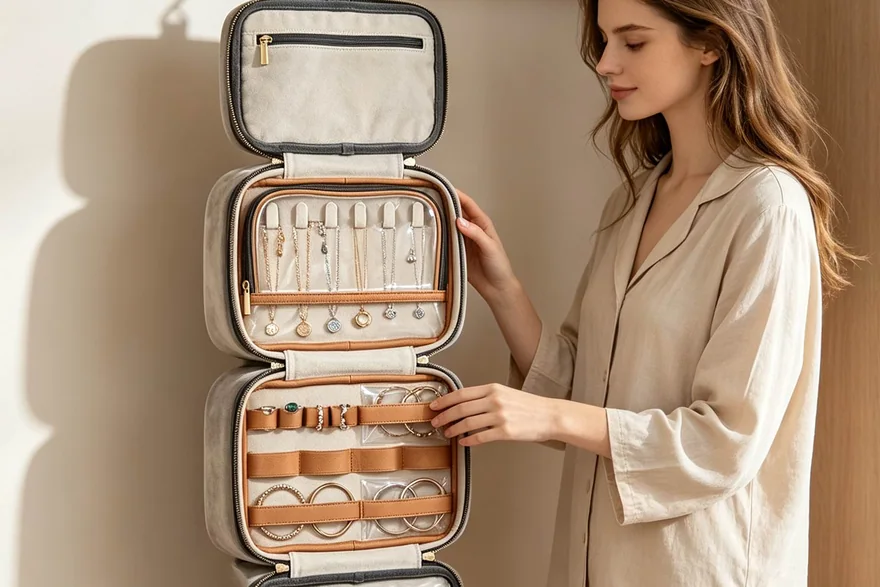
Cabin Bag, Personal Item and Liquids Bag: The Three-Slot System
A traveller moving through an airport is managing three separate allowances at once, and a cosmetic bag programme has to be designed against the tightest of them. The first is the cabin bag: the wheeled case or holdall that goes into the overhead locker. The second is the personal item: the smaller bag that fits under the seat in front, which on many European low-cost carriers is the only thing included in the base fare. The third is the liquids bag, which comes out of the cabin bag at security and is screened on its own.
The relationship between the three is where most confusion arises. On a full-service itinerary with a 55 x 40 x 20 cm cabin allowance, a cosmetic bag usually travels inside the cabin bag and the only hard constraint is the liquids bag. On a low-cost itinerary where the fare includes only a 40 x 20 x 25 cm personal item, the cosmetic bag competes directly with a laptop, a jacket and a bottle of water for the same fifteen litres, and a bag that seemed compact on a bathroom counter suddenly occupies a fifth of the entire allowance.
| Slot | Governing limit | Where the cosmetic bag sits | Failure mode |
|---|---|---|---|
| Cabin bag | Published external dimensions, usually around 55 x 40 x 20 to 23 cm, sometimes with a weight cap | Inside the case, alongside clothing | A rigid case of its own adds a second item to the count |
| Personal item | Published external dimensions for the under-seat bag, often 40 x 20 x 25 cm | Competing directly with other essentials | The bag fills the allowance and the rest of the kit has to be worn or checked |
| Liquids bag | One transparent reclosable bag of about one quart or 946 ml | Removed at the checkpoint and screened separately | Containers above 100 ml, or a bag too full to close |
There is no single worldwide standard. IATA publishes a cabin bag guidance that many carriers align with, but the guidance is a recommendation rather than a regulation, and each airline sets its own dimensions and weight cap by fare class. Some carriers enforce at the gate with a sizer frame; others weigh bags at the check-in desk. The design implication is straightforward: a cosmetic bag built for air travel should assume the smallest published allowance in the target market rather than the most generous one.
Airline Carry-On Allowances Compared
The table below sets out published cabin and personal-item allowances for a representative spread of carriers and the IATA guidance. Allowances change with fare family, aircraft type and season, and carriers revise them regularly, so the figures should be re-checked at booking; they are useful here because they show the span a cosmetic bag has to work across rather than because any single row is permanent. The key observation is the gap between full-service and low-cost allowances: roughly 30 litres of cabin volume against roughly 15 litres of personal-item volume.
| Carrier or guidance | Cabin bag maximum | Personal item | Weight limit | What it means for a cosmetic bag |
|---|---|---|---|---|
| IATA cabin bag guidance | 55 x 40 x 20 cm including wheels and handles | Not specified in the guidance | Guidance only, no weight figure | The reference point most full-service allowances cluster around |
| Ryanair | 55 x 40 x 20 cm, 10 kg, priority fare only | 40 x 20 x 25 cm included in the base fare | 10 kg on the priority trolley | A base-fare traveller has 20 litres for everything, so a flat pouch beats a structured case |
| Wizz Air | 55 x 40 x 23 cm with priority | 40 x 30 x 20 cm, about 10 litres, free | 10 kg on the trolley | The free allowance is the widest of the low-cost group but still under half a standard cabin case |
| easyJet | Cabin bag 45 x 36 x 20 cm including handles and wheels | Small under-seat bag on some fares | No published weight cap; the bag must be liftable | Depth is the binding constraint at 20 cm including handles |
| Lufthansa | 55 x 40 x 23 cm | One additional small item | 8 kg in economy | The 8 kg cap makes a heavy wash bag expensive in luggage terms |
| Air France | 55 x 35 x 25 cm | One accessory, combined allowance | 12 kg combined for cabin bag and accessory | A generous weight cap but a tight 25 cm width that favours a flat pouch |
| Emirates | 55 x 38 x 20 cm | One personal item | 7 kg in economy | The tightest weight cap in this group; empty bag weight matters |
| Qatar Airways | 50 x 37 x 25 cm | One personal item | 7 kg in economy | Shortest cabin length here, so a long roll-up pouch is a poor fit |
| Singapore Airlines | Total linear dimension 115 cm | One additional item on most fares | 7 kg in economy | Length is flexible, so a longer flat pouch is acceptable |
| Major US carriers | 22 x 14 x 9 in, about 56 x 36 x 23 cm | One personal item | No published weight limit on most domestic routes | Width and depth dominate; the liquids bag is the real constraint |
Two patterns are worth building into a product brief. First, weight caps of 7 to 8 kg make empty-bag weight commercially relevant: a 420 g structured hanging bag with hardware consumes roughly a tenth of a 7 kg allowance before a single bottle is added, and travellers notice. Second, the low-cost personal-item allowances are long and shallow or short and deep rather than cubic, which favours a wide, flat pouch over a boxy one. A bag designed against the IATA guidance alone will fail a Ryanair or Wizz Air sizer.
- Design for the smallest allowance in the target market: roughly 40 x 25 x 20 cm of usable personal-item space, not 55 x 40 x 20 cm
- Keep the empty bag light: every 100 g saved is 100 g of product that can be carried under a 7 kg cap
- Avoid a rigid silhouette: soft walls compress into the sizer frame; a moulded shell does not
- Keep the liquids pouch separable: the bag that comes out at the checkpoint should not be the whole kit
- Assume the fare may include only a personal item: the base-fare traveller is the strictest case, not the exception
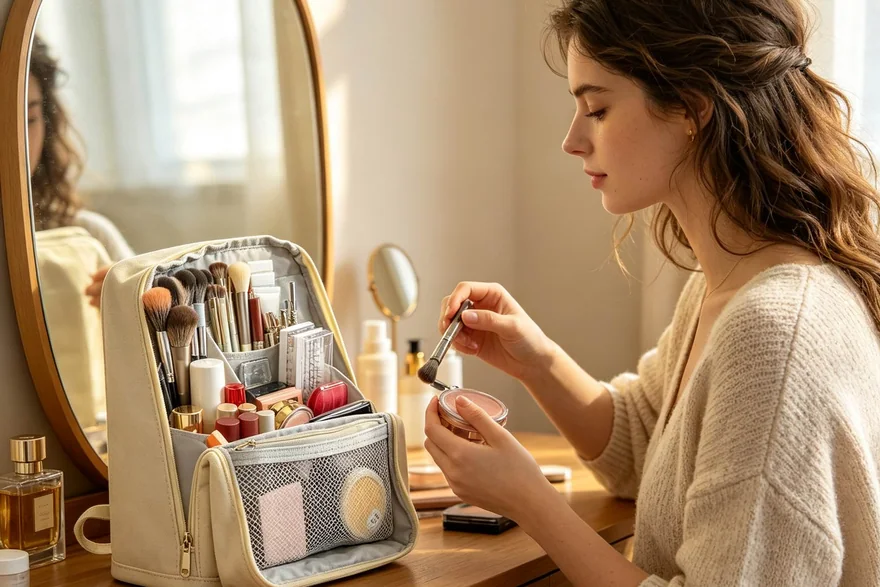
Packing Volume Maths: Sizing the Kit to the Trip
Volume is the wrong starting point; item count is the right one. A beauty kit is a collection of rigid objects of defined shape, and the size of the bag is set by how many objects have to lie side by side rather than by how many litres the shell encloses. The useful approach is to count the kit, convert it into a packed footprint, and then check that footprint against both the personal-item allowance and the liquids bag.
The liquids constraint is the one that surprises people. A one-quart reclosable bag, about 946 ml, will physically hold nine 100 ml bottles if they are slim cylinders, but it will not close comfortably around nine squat jars. Since the rule limits container size to 3.4 oz or 100 ml and requires all containers to fit in one bag that closes, the practical ceiling is around eight to nine containers including a toothpaste tube. The TSA liquids rule is the reference most travellers are measured against, and equivalent 100 ml limits apply at most major hubs outside the United States.
| Trip profile | Items in the kit | Liquids containers at 100 ml | Packed volume | Recommended bag size | Fits the quart liquids bag? |
|---|---|---|---|---|---|
| Overnight, one night | 6 items | 3 containers, 300 ml | 0.8 litres | 18 x 10 x 6 cm | Yes, easily, with room for a toothbrush |
| Weekend, two to three nights | 11 items | 6 containers, 600 ml | 1.6 litres | 22 x 13 x 8 cm | Yes, if the containers are slim |
| One week | 16 items | 9 containers, 900 ml | 2.6 litres | 25 x 15 x 10 cm | Borderline; the bag will not close around squat jars |
| Two weeks | 22 items | 12 containers, 1,200 ml | 3.8 litres | 28 x 17 x 12 cm | No; decant into smaller bottles or check a bag |
| Professional kit | 30 items or more | 14 containers, 1,400 ml | 6.0 litres | 32 x 20 x 14 cm | No; split the liquids across two travellers or check in |
Reading the table as a product brief produces a clear conclusion: the commercially interesting sizes sit at the weekend and one-week rows. Below that, a pouch is an amenity item rather than a travel product; above it, the kit stops fitting the carry-on liquids allowance and the traveller checks a bag anyway. A brand planning a travel range should therefore build the core size around 22 x 13 x 8 cm to 25 x 15 x 10 cm, and treat the larger sizes as a professional or vanity-case extension rather than as the travel proposition.
The same arithmetic works in reverse for a brand deciding what to put in a travel set. A kit of nine 100 ml containers leaves the quart bag full, so a ten-piece liquid set cannot be sold as a carry-on proposition however attractive the packaging. Sets are better built around six or seven liquid products with the remaining slots filled by solids, which sidesteps the constraint entirely.
- Count the kit first, then size the bag; volume follows item count, not the other way round
- Eight to nine slim 100 ml containers is the practical ceiling for one quart liquids bag
- The commercially useful travel sizes sit between 1.6 and 2.6 litres packed
- Above roughly 3.5 litres the liquids allowance breaks and the kit stops being carry-on viable
- A separate, removable liquids pouch lets the main bag stay packed at the checkpoint
Specifying a Carry-On-Optimised Cosmetic Bag
Once the allowances and the packing maths are understood, the specification writes itself. The binding constraints are external depth under a sizer frame, empty weight under a cabin weight cap, a removable liquids pouch, and a closure that survives being opened at a checkpoint with the bag in one hand. Each of those can be expressed as a number on a technical pack, and each has a test or a check attached.
| Design parameter | Carry-on requirement | Typical specification | How it is checked |
|---|---|---|---|
| Packed depth | Must pass a 20 cm sizer slot with handles and wheels included | Soft-walled body with a packed depth of 8 to 10 cm | Measure the loaded sample at the six external faces |
| External shape | Rectangular cross-section to use corner space | 25 x 15 x 9 cm with a tapered gusset | Pack into a test case with clothing and record wasted space |
| Empty weight | Under 200 g to protect a 7 kg cabin allowance | 210D to 420D nylon with a PU coating, plastic hardware | Weigh five production samples and take the mean |
| Liquids pouch | Removable, transparent, about one quart capacity | 0.25 to 0.4 mm TPU, welded seams, roughly 20 x 18 cm | Fill with nine 100 ml containers and confirm it closes |
| Closure | Opens one-handed at a checkpoint | Nylon coil zip with a low-profile slider and a pull tab | Zipper terminology specified to ASTM D2053; 500 open and close cycles |
| Carry system | Low profile so it lies flat in a sizer | Webbing loop or a folding hook that stows flat | Check that the folded hook adds under 5 mm to depth |
| Base | Resists a leaking bottle without a rigid frame | Welded or heat-sealed liner rather than a moulded base | Invert a filled water-filled pouch for four hours |
Materials follow the same logic. A soft-walled body in 210D or 420D nylon with a PU coating gives the combination of low weight, abrasion resistance and compressibility that a sizer frame rewards, and the coated fabric can be assessed against ASTM D751 for coating adhesion and strength. Where a transparent liquids pouch is part of the programme, TPU is preferable to PVC for the welded seam and for low-temperature behaviour in an aircraft hold, since PVC stiffens noticeably as temperature falls. Closure components on a bag that is opened at a checkpoint several times per trip should be specified with the same care, using the terminology set out in ASTM D2053 so that a slider, a pull tab and a coil gauge mean the same thing to the buyer and to the laboratory.
Airlines change allowances and no carrier certifies a cosmetic bag. Wording such as sized to fit a standard personal item allowance, with the dimensions printed beside it, is defensible; wording such as airline approved is not, and it invites a complaint from a carrier whose allowance the bag does not match.
Sampling should replicate the packing maths rather than the empty bag. A sample approved flat on a desk will behave differently from one loaded with nine bottles and pushed into a test frame, and the 6-10 working day standard sampling window is short enough to include a loaded trial. Complex constructions with welded liners and folding hooks fall into the 12-15 working day window. Bulk then runs 35-50 days after approval, with inspection at AQL 2.5 under ISO 2859-1, shipment FOB Xiamen and payment T/T 30 deposit and 70 against bill of lading.
The B2B Customisation View
The brief for makeup bags and toiletry bags should state the tolerances that matter: acceptable shade drift, stitch density, and the defect threshold at final inspection.
Programme data for this category: minimum order quantity 500 pieces per style and colourway, sampling in 6–10 working days (12–15 working days for complex constructions), bulk production 35–50 days after sample approval, final random inspection at AQL 2.5 under ISO 2859-1, FOB Xiamen, T/T 30/70.
This is the model that lets a small brand launch makeup bags and toiletry bags with the same inspection discipline a large retailer would demand.
Which Brand Types Benefit Most
A carry-on-optimised range suits buyers whose customer is already at the airport, and the reason differs by channel. An established luggage or travel brand can extend an existing cabin case with a matching pouch sized to the same allowance, which is a straightforward add-on sale. A start-up brand is better served by one correct size with printed dimensions on the label than by a three-size range, because the printed number is what the shopper checks against a booking confirmation. A retailer building a travel bay needs the dimensions on the packaging, since the purchase decision at shelf is a comparison against a number the shopper already has in mind. E-commerce sellers benefit most from carrying the centimetre figure and the quart-liquids compatibility in the listing title, because those are the phrases typed by a shopper with a booking confirmation open. Gift and hospitality buyers supplying airline amenity kits should follow the smallest allowance in the partner group, which on a mixed carrier list is usually the low-cost member, because an amenity kit that fails a sizer at the gate reflects badly on the airline rather than on the brand.
- Start-up brands: one size built around 25 x 15 x 9 cm, with the dimensions printed on the label and a removable liquids pouch as the differentiator
- Established travel and luggage brands: a pouch range matched to the brand's own cabin case allowance, so the two products are sold together
- Retailers: packaging that states packed dimensions and empty weight, because both are checked at the shelf against a booking
- E-commerce sellers: listing titles that carry the centimetre figure and the quart-liquids compatibility, since those are the search terms with purchase intent
- Gift and hospitality buyers: amenity kits for airline and hotel partners should follow the smallest partner allowance, which is usually the low-cost carrier in the group
Frequently Asked Questions
What is the IATA cabin bag guidance and does it apply to a cosmetic bag?
The IATA cabin bag guidance proposes a maximum of 55 x 40 x 20 cm including wheels and handles. It is guidance rather than regulation, and carriers set their own limits, so it is best used as the reference point rather than as a guarantee. A cosmetic bag is affected indirectly: it has to fit inside whatever the traveller's carrier allows, and low-cost personal-item allowances are considerably smaller.
Which is smaller, a low-cost carrier personal bag or a full-service cabin allowance?
The personal bag is much smaller. A typical low-cost personal-item allowance is about 40 x 20 x 25 cm, roughly 20 litres, against around 44 litres for a 55 x 40 x 20 cm cabin case. Some carriers include only the personal item in the base fare, so a cosmetic bag is competing with everything else the traveller carries rather than sitting inside a case.
Does a cosmetic bag count as a second bag on Ryanair or Wizz Air?
On those fares the free allowance is a single small personal item, so a cosmetic bag carried separately is a second item unless it fits inside the first. The practical answer is a pouch that fits within the under-seat bag rather than a case carried on top of it. Travellers who buy the priority fare gain a trolley allowance and the problem disappears.
How large can a liquids bag be under the TSA 3-1-1 rule?
The rule allows one quart-sized transparent reclosable bag, roughly 946 ml, holding containers of 3.4 oz or 100 ml or less, one bag per passenger, presented separately at the checkpoint. In practice the bag has to close, which limits the contents to around eight or nine slim containers. Commercial quart bags are typically about 20 x 18 cm.
Do solid cosmetics count against the liquids allowance?
Solid items such as powder compacts, solid shampoo bars, lipstick and stick deodorant are not liquids, gels or aerosols, so they do not have to go into the quart bag. This is why a solid-format kit travels more easily than a liquid one. Where a kit mixes formats, keeping the solids in the main bag and the liquids in the removable pouch speeds up the checkpoint.
Do US carriers publish a carry-on weight limit like European carriers do?
Most major US carriers publish external dimensions of about 22 x 14 x 9 in but no weight limit on domestic itineraries, while European carriers commonly apply a 7 to 12 kg cap. The practical effect is that empty bag weight matters less in the United States and much more in Europe and the Gulf, where a heavy structured wash bag consumes a visible share of the allowance.
What size cosmetic bag fits inside a 40 x 20 x 25 cm personal-item sizer?
Allow for the other items in the same bag and for the compression of a soft frame: a cosmetic pouch of about 22 x 13 x 8 cm leaves room for a tablet, a jacket and a bottle. Anything deeper than about 10 cm starts to force the rest of the contents out. A removable liquids pouch inside the same footprint is the most efficient arrangement.
Are liquids rules outside the United States the same 100 ml limit?
Most major hubs apply a broadly equivalent limit of 100 ml per container in a single transparent reclosable bag of about one litre, but the volume of the bag and the screening process vary by country and airport. Some airports now use computed tomography scanners that relax the bagging requirement. Travellers should check the departure airport rather than assume the US rule applies worldwide.
How much packed volume does a three-day beauty kit need?
A typical three-day kit runs to about eleven items including six liquids containers of 100 ml, which packs to roughly 1.6 litres. A bag of about 22 x 13 x 8 cm holds it with a little compression. Going smaller than that forces the traveller to choose between products, which is why the weekend size is the most commercially useful format in a travel range.
Should a carry-on cosmetic bag be rectangular or cylindrical?
Rectangular wins on two counts: it uses the corners of a case that a cylinder cannot reach, and it lies flat against the wall of a sizer frame. A cylindrical case of identical litre capacity presents a larger effective depth because the diameter is constant along its length. Where a brand wants a cylindrical silhouette for aesthetic reasons, keeping the diameter under 9 cm preserves the fit.
Does a hanging toiletry bag count against the cabin allowance?
Yes. A hanging bag is simply a toiletry bag with a hook, and it occupies space in the cabin bag or personal item like any other pouch. The relevant issue is packed geometry: the hook and the tiered structure add depth and weight, so a hanging bag is a better fit for a hotel bathroom than for a low-cost personal-item allowance.
How do sizer frames handle soft bags that bulge?
A sizer is a rigid box, so a soft bag that is overpacked either compresses into it or does not go in at all. The usable internal volume of a sizer is therefore smaller than its nominal litres suggest once compression is taken into account. Designing to a nominal dimension without a loaded trial is the most common reason a bag that measures correctly on paper fails at the gate.
What does a one-litre cosmetic bag look like in centimetres?
A pouch with internal dimensions of roughly 20 x 12 x 4.5 cm encloses about one litre, and a deeper pouch of 15 x 10 x 7 cm reaches the same volume. The shallow version is the better travel design because it slides against the wall of a case, while the deep version wastes vertical space that clothing could occupy.
Is a hard-shell case or a soft case better for a carry-on beauty kit?
A soft case is usually better for travel because it compresses into gaps and into a sizer frame, and because it weighs less against a 7 to 8 kg cap. A hard shell protects pressed powders and glass bottles better on a long journey. Where protection matters, a soft bag with a semi-rigid insert in the base gives most of the benefit at two-thirds of the weight penalty.
How can a brand state carry-on compliance on packaging without legal risk?
State the packed dimensions and the empty weight as measured, and describe the intended fit, for example sized to fit a standard personal item allowance. Avoid wording such as airline approved or TSA approved applied to the bag itself, since carriers do not certify bags and the approval in the liquids rule refers to container sizes, not to luggage.
What packed weight should a carry-on beauty kit stay under?
Under a 7 kg cabin cap, a packed kit of 1.2 kg consumes about a sixth of the allowance, which most travellers accept; beyond 2 kg the kit starts displacing clothing. Empty bag weight should stay under about 200 g so the hardware and fabric are not carrying the penalty. Weighing production samples and printing the figure is a competitive advantage.
People Also Ask
Can you take a full-size shampoo bottle in a carry-on?
Only if the container is 100 ml or smaller, because the limit applies to the container rather than to the amount left inside. A half-empty 400 ml bottle is not permitted. The practical alternative is decanting into 100 ml bottles and carrying them in the quart bag, or carrying solid shampoo bars, which are not treated as liquids at all.
What size toiletry bag is allowed on a plane?
There is no published limit for the toiletry bag itself; the limits apply to the cabin bag or personal item that contains it and separately to the liquids bag. In practice a pouch of about 25 x 15 x 9 cm fits a standard cabin case and most personal-item sizers, while the liquids pouch is limited to roughly one quart or 946 ml.
Why will a quart liquids bag close around nine bottles but not nine jars?
Around eight or nine slim cylindrical bottles, because the bag has to close comfortably for screening. Squat jars and wide tubes reduce that number to five or six even though the total volume is below 946 ml. Packing flat pouches or tubes alongside slim bottles uses the remaining space more efficiently than mixing shapes. Refillable flat tubes of the kind used for cleanser are the single most space-efficient liquid format for a quart bag.
Do makeup bags have to be clear at airport security?
The bag holding liquids has to be transparent so screeners can see the contents; the rest of the makeup bag does not. Keeping the liquids in one removable transparent pouch inside an opaque bag satisfies the requirement while allowing the outer bag to carry the brand's design. Powder, lipstick and other solids can stay in the opaque section. A removable pouch also means the liquids can be handed over without unpacking the whole kit at the checkpoint, which is the arrangement most frequent travellers converge on.
Request a Sample or a Written Quotation
Send the silhouette, dimensions, material preference and logo artwork, and the programme team will return a written quotation with MOQ, sampling window, bulk lead time and inspection standard.
Email: service@junyuanbags.com · WhatsApp: +86 177 5002 0688